 English
 Vietnamese
 French
- Home Page
- Religious News
- CAO DAI PARTICIPATES IN THE 2026 CESNUR INTERNATIONAL CONFERENCE ON RELIGION IN TAIWAN
CAO DAI PARTICIPATES IN THE 2026 CESNUR INTERNATIONAL CONFERENCE ON RELIGION IN TAIWAN
Updated 2026-10-20 08:10:29
(Taichung, Taiwan, October 15, 2026 – Reporting and photography by CaodaiTV)
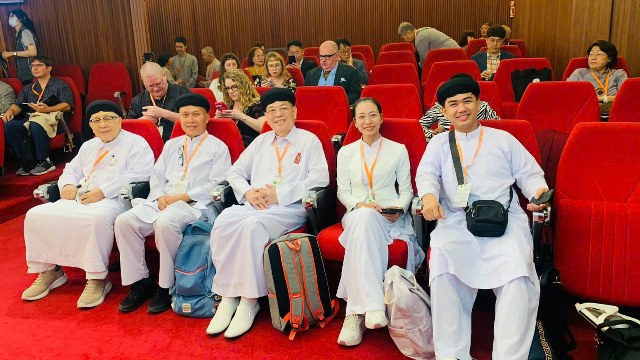
At 10:00 AM on the 2nd day of the 9th lunar month in the Year of the Horse (October 10, 2026), a delegation from the Cao Dai religion—representing the Tay Ninh Holy See—officially participated in the 2026 CESNUR Conference. The event, themed "New Religions and Spirituality in East Asia and Beyond – A Conference in Commemoration of Grand Master Hun Yuan Chan Shi," was held at the Weixin ShengJiao College in Nantou City, Taiwan. The program brought together esteemed researchers and scholars from over 20 countries.
The opening session featured addresses and welcoming remarks from the following distinguished guests:
1. Mr. Wu Ching-ji – Former Minister of Education of Taiwan
2. Mr. Ting Yu-chuan – President of the Wei Xin Sheng Jiao Association
3. Ms. Hsu Shu-hua – Magistrate of Nantou County
4. Mr. Chang Chia-che – Mayor of Nantou City
5. Professor Fiona Hsin-Fang Chang – Vice President of Wei Xin Sheng Jiao College
6. Professor Massimo Introvigne – Managing Director of CESNUR
The presence of these prominent scholars and representatives from various religious traditions underscored the significance of the event and the profound interest surrounding it. A notable highlight of the event occurred during the first plenary session, held from 10:25 to 12:00 that same day, when the head of the Cao Dai delegation—Rev. Thượng Cảnh Thanh (Trần Quang Cảnh)—was entrusted by the Organizing Committee to serve as the chair for this significant session.
This represents a truly unique and proud precedent. Typically, the role of chair for plenary sessions is subject to a rigorous selection process and is usually assigned to a professor or a PhD scholar from among the presenters. The fact that Rev.Thượng Cảnh Thanh occupied the central position, surrounded by distinguished speakers—including Professor Fiona Chang (Taiwan), Professor Lee Fong-Mao (Taiwan), Professor Bernadette Rigal-Cellard (France), Professor Benjamin Penny (Australia), and Professor Bae Kyuhan (South Korea)—serves as an invaluable form of recognition. It confirms that, after more than 20 years of persistent participation and the integration of the Cao Dai faith into the secular sphere through CESNUR conferences, the reputation and significance of Cao Dai are now held in high regard internationally.
At 15:00, following the first day’s discussions, the approximately 80 conference attendees gathered for a commemorative photograph in the courtyard. Subsequently, the Cao Dai delegation and the international guests were invited to participate in a blessing ceremony and to sign roof tiles intended for the construction of a grand hall at the Duy Tâm Thánh Giáo (Duy Tam Sacred Teachings) Academy. Once completed, this hall is expected to have a total capacity of 8,000 people.
At 16:00, the Organizing Committee escorted the guests to Thiền Cơ Sơn Tiên Phật Tự—the ancestral temple of the Duy Tâm Thánh Giáo tradition—located in Nantou, Taiwan. At this venue, Professor Fiona Chang—Abbess of the Chan-Chi-Shan Hsien-Fo Temple and Vice President of the I-Ching Sacred Religion Academy—led international guests in a prayer and commemoration for the late Hunyuan Chanshi, the former Grand Master of the I-Ching Sacred Religion in Taiwan. It was a deeply sacred and poignant moment.
Notably, Session 14 took place from 17:00 to 18:30 on Sunday, October 11, 2026, at the I-Ching Sacred Religion center in Taichung. Moderated by Dr. Jason Paul Greenberger, the session featured presentations and discussions on three in-depth research topics concerning Caodaism:
1) Professor Christopher Hartney (University of Sydney, Australia) explored the creative use of the "Ancestral Family" (*Tông Đường*) within the vision of a living sacred realm as articulated by *Hộ Pháp* (Protector of the Dharma) Phạm Công Tắc.
2) Doctoral candidate Nguyễn Tuấn Em (National Chengchi University, Taipei, Taiwan) offered a comparative perspective on the means of salvation and the guidance of souls, drawing parallels between Caodaism and ancient Egyptian traditions.
3) Doctoral candidate Phạm Hoàng Anh Tuấn (University of Sydney, Australia) presented a critical examination of "religion" as a research methodology, using the case of Caodaism.
These presentations drew significant interest, prompting numerous questions and discussions from professors and scholars from France, the United States, and South Korea. The gathering of scholars from numerous countries, all focused on the specific subject of Caodaism, demonstrates that Caodaism is not only a unique religious tradition but also a promising field of academic inquiry, making a substantive contribution to the global treasury of spiritual culture.
In total, nearly 80 academic papers were presented, covering a broad spectrum of topics—ranging from historical research and methodology to contemporary spiritual phenomena. The participating professors, doctors, researchers, and speakers represent leading research institutes and universities from nearly 20 countries and territories, including:
- Asia: Taiwan, South Korea, Japan, Vietnam, and Hong Kong (China).
- Europe: France, the United Kingdom, Italy, Belgium, the Czech Republic, Hungary, Poland, and Romania.
- The Americas: The United States, Canada, and Argentina.
- Oceania: Australia.
- Africa & the Middle East: South Africa and Israel.
Centered on the primary theme of "New Religions and Spirituality in East Asia and Beyond," the conference was organized into several in-depth research tracks, such as Eastern culture (the I Ching, Feng Shui) and spiritual practice, New Religious Movements in Asia, and spirituality in the digital age.
Overall, the participation of the Cao Dai delegation—led by *Giao huu* (Reverend) Thuong Canh Thanh—carries a positive significance that transcends the scope of a mere academic forum. In this new era, as humanity faces numerous upheavals and cultural fractures, the presence of the Cao Dai faith serves as a vivid testament to the effort to bridge diverse religious traditions.
The conference acted as a conduit for sharing the practical application of moral and ethical living: from embracing differences and promoting love, to fostering a wholesome lifestyle and safeguarding the lives of all humanity. This embodies the path of integrating faith into daily life—using harmony to build a prosperous and peaceful human community.
Over the following two days, October 13–14, 2026, the organizing committee guided the Cao Dai delegation and international guests on visits to various local religious and cultural sites, including:
1) The Lei-li-a (Lôi Lực) Sanctuary of the *Tian Di Jiao* (Heavenly Emperor Religion)—the headquarters of one of the major messianic new religious movements among the Chinese people.
2) Zhongxing New Village (Trung Hưng Tân Thôn)—a well-preserved traditional Taiwanese village—where participants enjoyed a guided cultural tour and a hands-on (DIY) experience in preparing wellness-focused herbal tea.
3) Mount Zion (Tích An)—the headquarters of the New Testament Church, a Christian-based new religious movement that originated in Taiwan and has since spread to many other countries. The site features a museum that chronicles the movement’s history—a compelling narrative of enduring persecution with remarkable resilience. Currently, approximately 400 members live together as a community at Mount Zion.
On October 15, 2026, the delegation from the Cao Dai Tay Ninh Holy See departed Taiwan and returned to Tan Son Nhat Airport in Vietnam, successfully concluding this mission to propagate the Great Way (Đại Đạo).
In conclusion, since the commencement of these outreach efforts in 1998—which included participation in various international conferences and academic forums—the Cao Dai faith, through its Overseas Missionary Agency under the guidance of Rev. Thượng Cảnh Thanh, has gained recognition among numerous international scholars and university professors. Many have expressed a desire to visit the Tay Ninh Holy See to learn more about this unique new religion, which emerged during the 20th and 21st centuries. Notably, this approach to propagating the Cao Dai faith was addressed as early as 1928 in France by the renowned Spiritist Léon Denis, who discussed the connection between the Spiritist movement of Allan Kardec and the Cao Dai faith. This communication occurred via a *cơ bút* (spirit-writing/automatic writing) session on February 3, 1928. In it, Léon Denis advised Cao Dai followers on three key strategies for propagating their religion:
1) Persuade intellectuals first.
2) Participate in a wide range of conferences.
3) Propagate the faith by setting an example.
The Overseas Missionary Agency has consistently implemented these points over the past 28 years.
Below are some images from the aforementioned 2026 CESNUR conference:
OPENING CEREMONY
_640x480.jpg)
_640x480.jpg)
_640x427.jpg)
_639x480.jpg)
_640x427.jpg)
_639x480.jpg)
_640x427.jpg)
_640x427.jpg)
_639x480.jpg)
_639x480.jpg)
_640x427.jpg)
_639x480.jpg)
_639x480.jpg)
_640x427.jpg)
_360x480.jpg)
_639x480.jpg)
_639x480.jpg)
_640x427.jpg)
_640x427.jpg)
_640x427.jpg)
_640x427.jpg)
_640x427.jpg)
_640x427.jpg)
_640x427.jpg)
_640x427.jpg)
FIRST PLENARY SESSION
_640x427.jpg)
_640x427.jpg)
_640x427.jpg)
_640x427.jpg)
_640x427.jpg)
_640x427.jpg)
_640x427.jpg)
_640x427.jpg)
_639x480.jpg)
_640x427.jpg)
_640x427.jpg)
_640x427.jpg)
_640x427.jpg)
_640x427.jpg)
_640x427.jpg)
_639x480.jpg)
_639x480.jpg)
_640x427.jpg)
_640x427.jpg)
_640x427.jpg)
_640x427.jpg)
_640x427.jpg)
_639x480.jpg)
_640x427.jpg)
BLESSING CEREMONY AND ROOF TILES SIGNING
_640x480.jpg)
_639x480.jpg)
_639x480.jpg)
_640x427.jpg)
_640x427.jpg)
_639x480.jpg)
_639x480.jpg)
_640x427.jpg)
_640x427.jpg)
_640x427.jpg)
_640x427.jpg)
_320x480.jpg)
_600x480.jpg)
_640x427.jpg)
_360x480.jpg)
_640x427.jpg)
_640x427.jpg)
_640x480.jpg)
VISIT AND PRAYER AT GRAND MASTER ALTAR
_640x427.jpg)
_640x427.jpg)
_640x427.jpg)
_320x480.jpg)
_640x427.jpg)
_640x427.jpg)
_640x427.jpg)
_640x427.jpg)
_640x427.jpg)
_640x427.jpg)
_640x427.jpg)
_640x427.jpg)
_640x427.jpg)
_640x360.JPG)
_640x427.jpg)
PRESENTATION ON CAODAISM
_640x427.JPG)
_640x427.JPG)
_640x427.JPG)
_640x427.JPG)
_640x427.JPG)
_640x427.JPG)
_640x427.JPG)
_640x427.JPG)
_640x427.JPG)
_640x427.JPG)
_640x427.JPG)
_640x427.JPG)
_640x427.JPG)
_640x427.JPG)
_640x427.JPG)
_640x427.JPG)
_640x427.JPG)
_640x427.JPG)
_640x427.JPG)
_640x427.JPG)
_640x427.JPG)
_640x427.JPG)
_640x427.JPG)
_640x427.JPG)
_640x427.JPG)
_640x427.JPG)
_640x427.JPG)
_640x427.JPG)
_640x427.JPG)
_640x427.JPG)
_640x427.JPG)
_640x427.JPG)
SIGHTSEEING TOUR TO CHURCH AND TEMPLE
At the Sanctuary of the *Tian Di Jiao*
_640x360.JPG)
_640x360.JPG)
_640x360.JPG)
_640x360.JPG)
_640x360.JPG)
_640x360.JPG)
_640x360.JPG)
_640x360.JPG)
_640x360.JPG)
_640x360.JPG)
_640x360.JPG)
_270x480.JPG)
_270x480.JPG)
_640x360.JPG)
_640x360.JPG)
_640x360.JPG)
_640x360.JPG)
_640x360.JPG)
_640x360.JPG)
_640x360.JPG)
AT MOUNT ZION - NEW TESTAMENT CHURCH
_640x360.JPG)
_640x360.JPG)
_640x360.JPG)
_640x360.JPG)
_640x360.JPG)
_640x360.JPG)
_640x360.JPG)
_640x360.JPG)
_640x360.JPG)
_640x360.JPG)
_640x360.JPG)
_640x360.JPG)
_640x360.JPG)
_640x360.JPG)
_640x360.JPG)
_640x360.JPG)
_640x360.JPG)
_640x360.JPG)
_640x360.JPG)
_640x360.JPG)
_640x360.JPG)
_640x427.JPG)
_640x427.JPG)
_640x427.JPG)
_640x427.JPG)
_640x427.JPG)
SOME SOUVENIR PHOTOS
_640x427.JPG)
_640x427.JPG)
_640x427.JPG)
_640x427.JPG)
_640x427.JPG)
_640x427.JPG)
_640x427.JPG)
_640x427.JPG)
_640x427.JPG)
_640x427.JPG)
_640x427.JPG)
_640x427.JPG)
_640x427.JPG)
_640x427.JPG)
_640x427.JPG)
_640x427.JPG)
_640x427.JPG)
_640x427.JPG)
_640x427.JPG)
Other News
- CAO DAI ATTENDS THE 250TH ANNIVERSARY CELEBRATION OF THE UNITED STATES' INDEPENDENCE DAY IN HO CHI MINH CITY (2026-07-12 15:13:23)
- NEW CONSUL GENERAL OF THE UNITED STATES IN HO CHI MINH CITY VISITS CAO DAI HOLY SEE IN TAY NINH (2026-05-21 08:27:18)
- DHAKA UNIVERSITY STUDENTS, BANGLADESH, HAVE COMPLETED THE COURSE (2026-05-20 09:42:53)
- REPRESENTATIVE OF THE PROTESTANT CHURCH OF BAVARIA (GERMANY) VISITS THE CAO DAI HOLY SEE (2026-04-10 07:58:33)
- FAREWELL CEREMONY FOR GRAND MASTER HUNYUAN CHANSHI, FOUNDING PATRIARCH OF WEIXIN SHENGJIAO TAIWAN (2026-03-16 19:28:00)

 Latest Posts
 Calendar
 Counter statistics